Utility-scale solar power has crossed a major economic milestone: it now ranks among the cheapest ways to generate electricity, often undercutting new fossil fuel plants on cost alone.
That conclusion is backed by multiple independent assessments. Financial firm Lazard’s 2025 Levelized Cost of Energy+ (LCOE+) report, (Lazard) widely used by energy analysts, finds that utility-scale solar and wind remain the most cost-competitive sources of new generation in the U.S. on an unsubsidized basis — meaning before federal tax incentives are counted.
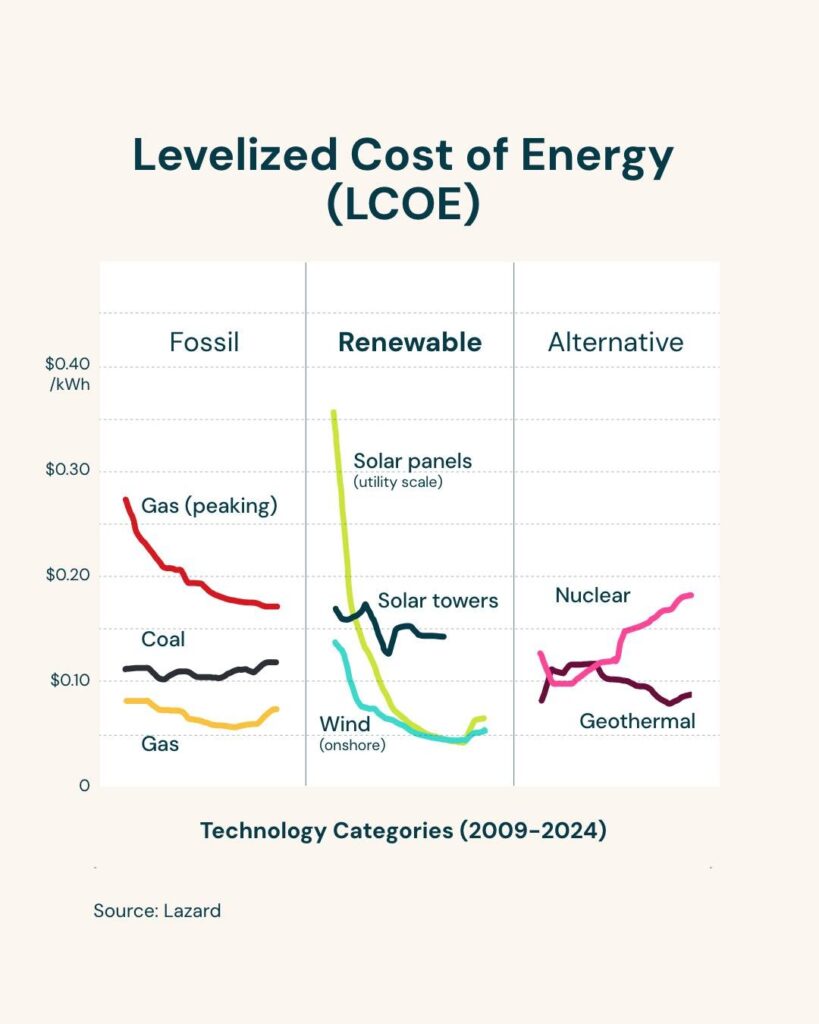
In plain terms, this means that building a new solar farm today often costs less per unit of electricity produced than building a new natural gas plant, and is cheaper than even the least expensive fossil fuel plants when subsidies aren’t factored in. (PV Magazine)
Globally, the International Renewable Energy Agency (IRENA) reports that in 2024, about 91% of newly commissioned renewable power delivered electricity at a lower cost than the cheapest fossil alternatives, helping energy systems avoid hundreds of billions in fuel costs. (Irena)
These cost improvements didn’t appear overnight. Over the past decade, the price of solar PV modules and the cost to install them have plunged due to scale-up in manufacturing, supply chain improvements, and technological advances. Independent data shows that solar’s levelized cost of electricity has dropped by roughly 80–90% since 2010.
As a result, solar is no longer just the clean choice — it’s often the smartest economic choice. Even industry critics acknowledge that renewable LCOE figures have reshaped investment decisions in power markets. (Our World in Data)
“Solar has moved from being a climate-friendly alternative to an economic default.”
Investors increasingly favor solar in planning new generation capacity because it promises stable, predictable costs over decades, whereas fossil fuels face volatile fuel prices and emissions risk.
Still, cost is only one part of the picture. Balancing solar’s intermittent output with storage, grid upgrades, and regional energy demands will remain a focus for energy planners. But even with those challenges included, solar’s competitive cost makes it central to how power systems will be built in the coming decade.